

29 de mayo 2026
Introduction
Acute appendicitis is one of the most common causes of surgical acute abdomen in children. However, several infectious and inflammatory disorders may closely mimic appendicitis, including terminal ileitis and mesenteric adenitis. These conditions often present with fever, right lower quadrant pain, localized abdominal tenderness, and elevated inflammatory markers, making clinical differentiation challenging during the initial evaluation.
Campylobacter species are among the most common bacterial causes of gastroenteritis worldwide and have a recognized predilection for the terminal ileum and cecum. In selected cases, Campylobacter infection may produce terminal ileitis and reactive mesenteric lymphadenopathy, resulting in a clinical presentation nearly indistinguishable from acute appendicitis.
We report the case of a 3-year-old boy with Campylobacter-associated terminal ileitis and reactive mesenteric adenitis presenting as suspected acute appendicitis with elevated Alvarado and AIR scores.
Justification
This case was selected because the patient presented with clinical findings, laboratory abnormalities, and appendicitis prediction scores suggesting a moderate-to-high probability of acute appendicitis. Nevertheless, cross-sectional imaging demonstrated an alternative diagnosis, and subsequent microbiological testing established a definitive infectious etiology, allowing conservative management and avoiding unnecessary surgical referral and intervention.
Case Presentation | Medical History and Anamnesis
A previously healthy 3-year-old boy presented to the emergency department with fever and acute right lower quadrant abdominal pain. According to his caregivers, symptoms had progressively worsened prior to medical evaluation. There was no history of previous abdominal surgery, chronic gastrointestinal disease, abdominal trauma, or known inflammatory bowel disease. Because acute appendicitis was strongly suspected, clinical prediction tools were applied.
- Alvarado Score: 8 points
- Appendicitis Inflammatory Response (AIR) Score: 6 points
Both scores suggested a moderate-to-high probability of acute appendicitis.
Physical Examination
The patient appeared uncomfortable but remained hemodynamically stable. Abdominal examination demonstrated localized tenderness in the right lower quadrant with a positive McBurney point tenderness. No rebound tenderness, guarding, abdominal distension, or generalized peritoneal irritation was present.
Laboratory Evaluation
Initial laboratory studies demonstrated:
- White blood cell count: 10.84 ×10³/µL
- Neutrophils: 83.2%
- Absolute neutrophil count: 9.02 ×10³/µL
- C-reactive protein (CRP): 21.34 mg/L
These findings further increased the suspicion of acute appendicitis.
Imaging Findings
Because of the elevated appendicitis scores and persistent clinical concern, a contrast-enhanced CT scan of the abdomen and pelvis was obtained.
CT demonstrated:
- Circumferential wall thickening of the terminal ileum measuring approximately 7 mm
- Involvement of approximately 7 cm of terminal ileum
- Multiple reactive mesenteric lymph nodes within the right lower quadrant measuring up to 10 mm
- Appendix measuring approximately 6 mm with intraluminal gas
- No periappendiceal fat stranding
- No appendiceal wall thickening
- No abscess formation
- No free intraperitoneal air
- No free fluid
These findings were consistent with terminal ileitis and reactive mesenteric adenitis rather than acute appendicitis.
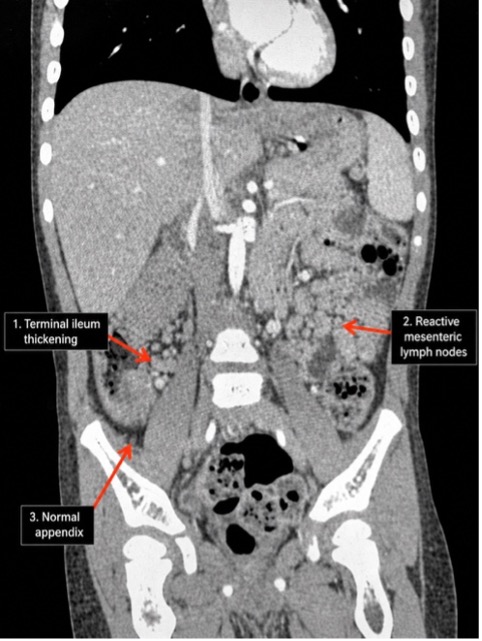
Figure 1. Contrast-enhanced coronal CT image demonstrating terminal ileal wall thickening and reactive mesenteric lymphadenopathy in the right lower quadrant. The appendix appeared non-inflamed.
Microbiological Investigation
Multiplex gastrointestinal polymerase chain reaction (PCR) testing was subsequently performed.
The study detected:
- Campylobacter species: Positive
- Ct value: 25.1
The following pathogens were negative:
- Salmonella
- Shigella
- Yersinia enterocolitica
- Vibrio species
- Pathogenic Escherichia coli strains
- Adenovirus
- Rotavirus
- Norovirus
- Giardia lamblia
- Entamoeba histolytica
- Other tested bacterial, viral, and parasitic pathogens
Based on the imaging findings and microbiological confirmation, the final diagnosis was Campylobacter-associated terminal ileitis with reactive mesenteric adenitis.
Final Diagnosis
- Campylobacter enteritis
- Terminal ileitis
- Reactive mesenteric adenitis
Clinical Course and Outcome
Based on the clinical presentation, laboratory abnormalities, and elevated appendicitis prediction scores, acute appendicitis was initially considered the most likely diagnosis. However, CT imaging excluded appendiceal inflammation and established terminal ileitis with reactive mesenteric adenitis. Subsequent PCR testing confirmed Campylobacter infection. The patient was admitted for observation and pediatric reassessment. Conservative management consisting of clinical monitoring, hydration, antipyretics, and analgesics was implemented. The patient demonstrated favorable clinical evolution without progression of abdominal pain, development of peritoneal signs, or need for surgical intervention. Unnecessary surgical referral and appendectomy were successfully avoided.
Discussion
Terminal ileitis and mesenteric adenitis are important mimics of acute appendicitis in pediatric patients. Both conditions may present with fever, right lower quadrant pain, localized tenderness, neutrophilia, and elevated inflammatory markers. In the present case, the diagnostic challenge was amplified by elevated appendicitis prediction scores. The patient achieved an Alvarado score of 8 and an AIR score of 6, values generally considered compatible with a moderate-to-high probability of appendicitis. Despite these findings, contrast-enhanced CT demonstrated terminal ileal inflammation and reactive mesenteric lymphadenopathy while showing a normal appendix without inflammatory changes.
Campylobacter species have a recognized predilection for the terminal ileum and cecum. Infection may result in terminal ileitis, mesenteric adenitis, and right lower quadrant pain, producing a clinical syndrome nearly indistinguishable from appendicitis. This case illustrates an important limitation of appendicitis prediction tools. Although these scores are useful for identifying patients at increased risk of significant right lower quadrant inflammation, they do not establish a definitive diagnosis and cannot reliably distinguish appendicitis from infectious terminal ileitis. Cross-sectional imaging and microbiological confirmation were essential in establishing the correct diagnosis and preventing unnecessary surgical intervention.
Conclusion
Campylobacter-associated terminal ileitis should be considered in the differential diagnosis of pediatric patients presenting with right lower quadrant abdominal pain suggestive of acute appendicitis.
High Alvarado and AIR scores do not exclude alternative diagnoses. Advanced imaging and microbiological testing may be critical in selected patients to establish the correct diagnosis and avoid unnecessary surgical referral or appendectomy.
References
- Özcan UA, Şimşek S, Çetin B, et al. Comparison of Clinical and Laboratory Manifestations Between Acute Appendicitis and Mesenteric Lymphadenitis in Children. Cureus. 2024;16:e62399.
- Ciftci AO, Yilmaz EA, Ince E, et al. Clinical Evaluation and Outcomes of Mesenteric Lymphadenopathy in Children. Cureus. 2025;17:e80649.
- Ramachandran M, Kirkby-Bott J. Ultrasound Findings and Their Utility in Paediatric Mesenteric Adenitis. Ultrasound. 2026.
- Man SM. The clinical importance of Campylobacter infections. Nature Reviews Gastroenterology & Hepatology. 2011;8:669–685.
- Ternhag A, Törner A, Svensson Å, et al. Short- and long-term effects of bacterial gastrointestinal infections. Emerging Infectious Diseases. 2008;14:143–148.
Cite esta colaboración: Héctor Abraham Rojina López ”Campylobacter Terminal Ileitis and Reactive Mesenteric Adenitis Mimicking Acute Appendicitis in a 3-Year-Old Boy with Elevated Alvarado and AIR Scores: A Case Report, blog EMergiendo SMME, Julio 2026. Disponible en: https://emergiendo.org.
Editor revisor: Dr. Manuel Nicanor Caballero Sevilla

Dr. Héctor Abraham Rojina López
-
Emergency Medicine Specialist
-
Family Medical Practice, Ho Chi Minh City, Vietnam